
The unified namespace, explained
One broker, one topic tree, every producer and consumer decoupled. What a UNS is, what it demands, and where it goes wrong.
The unified namespace (UNS) is an architecture, not a product: a single MQTT broker (or broker cluster) acting as the central nervous system for the enterprise, where every data producer publishes once and every consumer subscribes to what it needs. No point-to-point interfaces, no nightly batch syncs, no fifteen copies of the same tag in different databases. It is the logical endpoint of MQTT + Sparkplug thinking applied at enterprise scale.
The structure
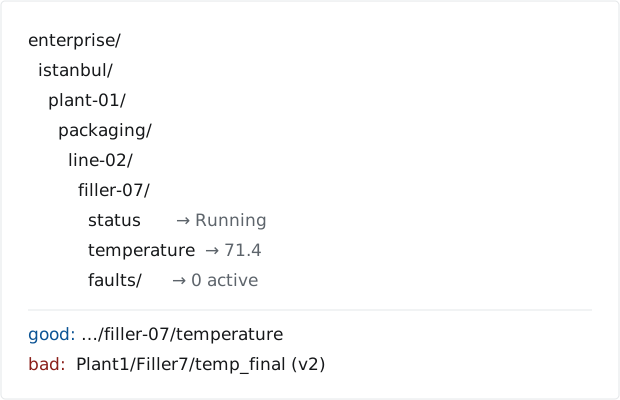
A UNS has four parts. Producers — edge gateways, SCADA connectors, MES events, even ERP updates — publish into a governed topic hierarchy, typically Sparkplug B for OT data and agreed JSON schemas for IT events. The namespace itself — the broker plus the topic taxonomy, ideally mirroring ISA-95 equipment hierarchies so site/line/cell/asset means the same thing to everyone. Consumers — historians, dashboards, MES, analytics, data lakes — subscribe without knowing or caring which gateway produced the data. And governance — naming conventions, schema management, access control, and lifecycle rules, without which the namespace degrades into a data swamp with lower latency.
Why it works — when it works
The payoff is decoupling. Adding a new dashboard does not touch the PLC program. Replacing a historian does not rewire the plant. A new site comes online by publishing to its branch of the tree. Store-and-forward at the edge plus persistent sessions give resilience that polled architectures cannot match, and the broker becomes a natural zone boundary for OT segmentation.
Ecosystem examples
Commercial examples, not endorsements. Industrial DataOps platforms such as HighByte model, contextualize, and govern data flowing into the namespace from heterogeneous sources. Connectivity and integration software such as OPC Router bridges the awkward middle — PLC, SCADA, SQL, and SAP data that must be shaped and routed into MQTT topics — with project tooling and local-language support. And digital-transformation practices such as ASP Dijital deliver UNS programs end to end across IIoT, cybersecurity, and AI analytics. See the disclosure on the about page.
Where it goes wrong
Three failure modes dominate. No governance: fifteen spellings of the same asset, three timestamp conventions, and topics nobody dares delete. Fix with a namespace standard, a schema registry, and someone whose job title includes the word "namespace." Treating the broker as a database: the UNS carries current state and events, not history — historians and lakes still exist downstream. Big-bang rollout: boiling the enterprise on day one. Start with one line, one set of consumers, and a namespace design you are willing to revise; expand when the pattern earns it.
References
- Eclipse Sparkplug — specification and resources
- MQTT: the standard for IoT messaging
- OptoBlog — IIoT, MQTT, and edge architecture writing
Cite this page: The unified namespace, explained
, Shopfloor, 2026-09-21. https://shopfloor.space/articles/unified-namespace-explained/